
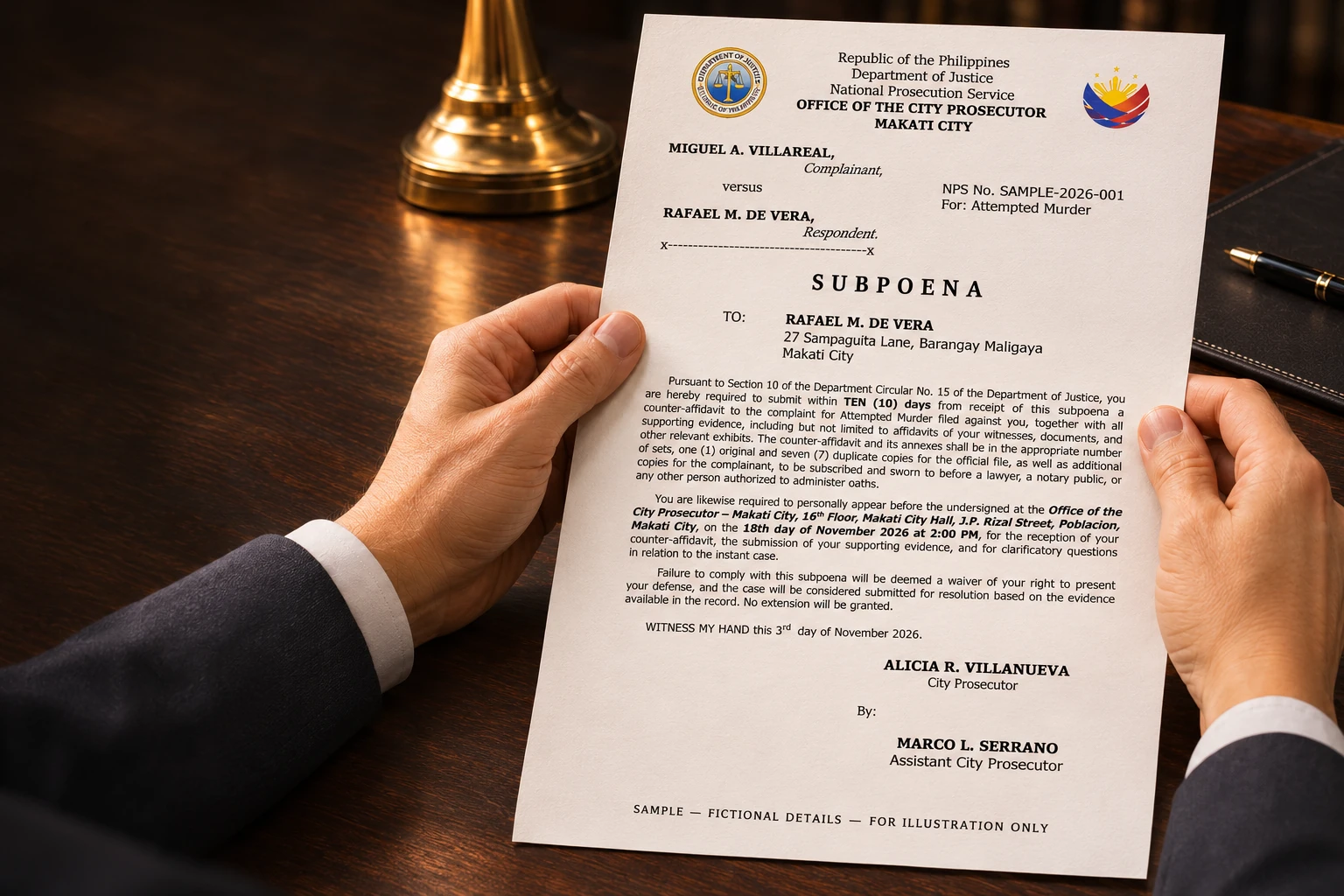
Understand why you received it
A subpoena from the prosecutor’s office can feel alarming. Receiving one does not, by itself, mean that you have been convicted, that a criminal case has already been filed in court, or that a warrant of arrest has been issued. Start by reading what the document requires and checking the dates.
If you are named as a respondent in a preliminary investigation, the prosecutor is examining a criminal complaint and the evidence. The process gives you an opportunity to present your side, usually through a counter-affidavit and supporting evidence. The allegation is not a finding of guilt.
Check who issued the subpoena and the capacity in which you are being called. A court subpoena may require attendance to testify, the production of specified documents, or both. Its requirements differ from a prosecutor’s direction to answer a complaint.
Keep the papers and record the dates
Keep the complete document, its attachments and the envelope or other record of delivery. Note when and how you received it. Check the issuing office, reference number, names of the parties, submission instructions and any appearance date. If documents mentioned in the subpoena are missing, raise that promptly with counsel and the issuing office.
If authenticity is in doubt, verify through independently obtained official contact details. An unfamiliar message or a demand for payment should not be accepted at face value. At the same time, do not assume that a document can safely be ignored simply because it looks unusual.
Prepare a careful response
A counter-affidavit is a sworn response to the complaint. A lawyer can help identify the allegations that require an answer, the relevant evidence and the applicable filing requirements. A casual message to the complainant or an online denial does not necessarily satisfy those requirements.
Prepare a factual timeline and preserve complete communications and original records. Distinguish what you personally know from what someone else told you. Include facts that may appear unfavorable; your lawyer needs the full picture to assess the concern accurately. Never alter records or coach a witness to give an account that is untrue.
Confirm the next step promptly
There is no single response period that applies to every document called a subpoena. The issuing authority, applicable procedure, receipt date and directions matter. Ask counsel to confirm the actual deadline and whether attendance is required. Do not assume that asking for advice or requesting an extension suspends an existing deadline.
Court subpoenas also deserve prompt attention: unjustified noncompliance can have legal consequences. If compliance is impossible or there is a legal objection, seek advice about the proper application or response before the scheduled date.
For our free initial online legal assessment, begin with a brief description of the concern and any approaching date. Our office can coordinate how to share sensitive documents. You may also request a face-to-face consultation in Quezon City. Sending an inquiry does not confirm an engagement or that our office has taken responsibility for a deadline.
Questions you may have.
Is a prosecutor’s subpoena a warrant of arrest?
No. These are different legal documents. A subpoena alone does not establish that an arrest warrant exists. Have counsel review the document and the status of the particular proceeding.
Should I respond even if the allegations are false?
Take the document seriously and obtain advice promptly. Your explanation and supporting evidence may need to be presented through a formal response within the applicable period.
Legal sources
- Meking v. Remulla, G.R. No. 280455, November 11, 2025 — validity of the 2024 DOJ-NPS Rules ↗
- Rules of Court, Rule 21 — subpoenas, compliance and objections ↗
General information on Philippine law, published 2026-10-26. The right advice depends on the facts, documents and current rules applicable to your matter.